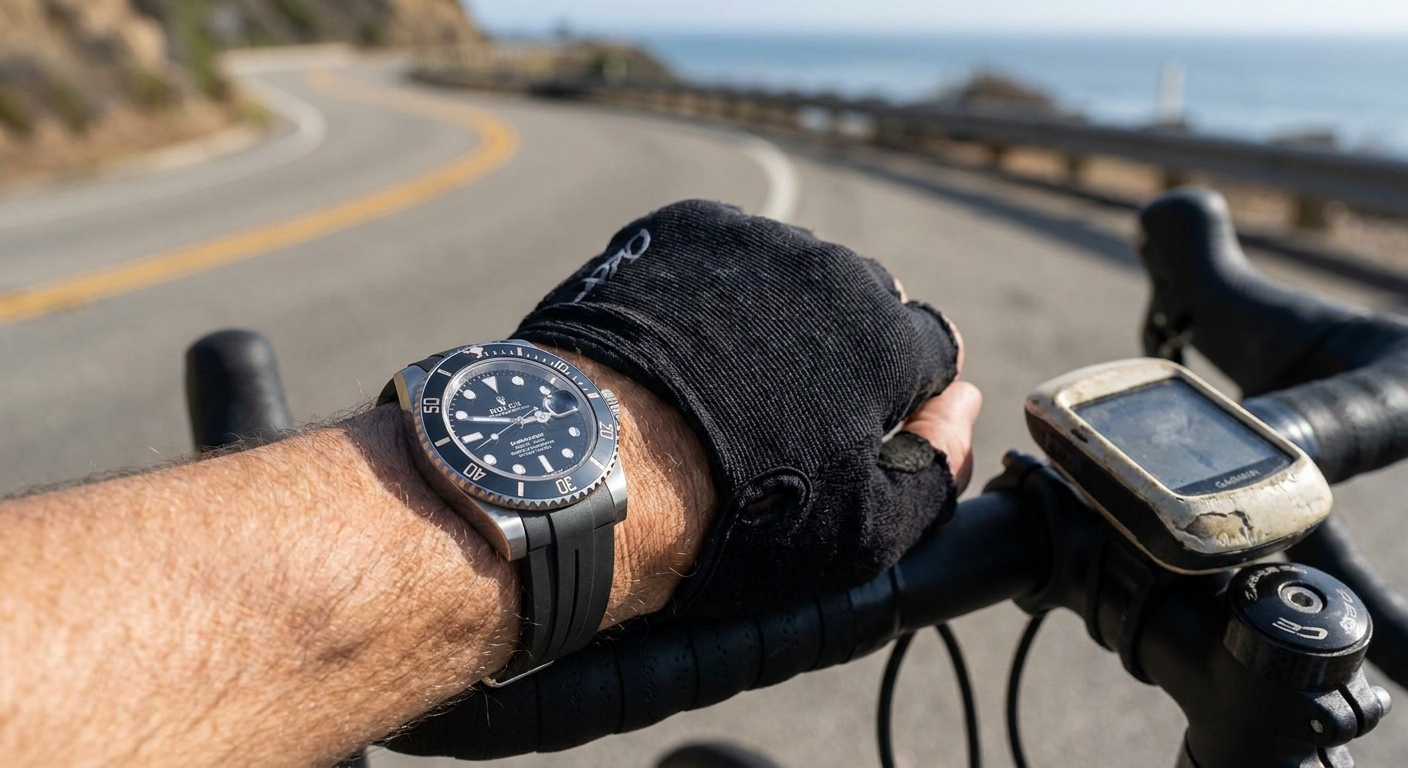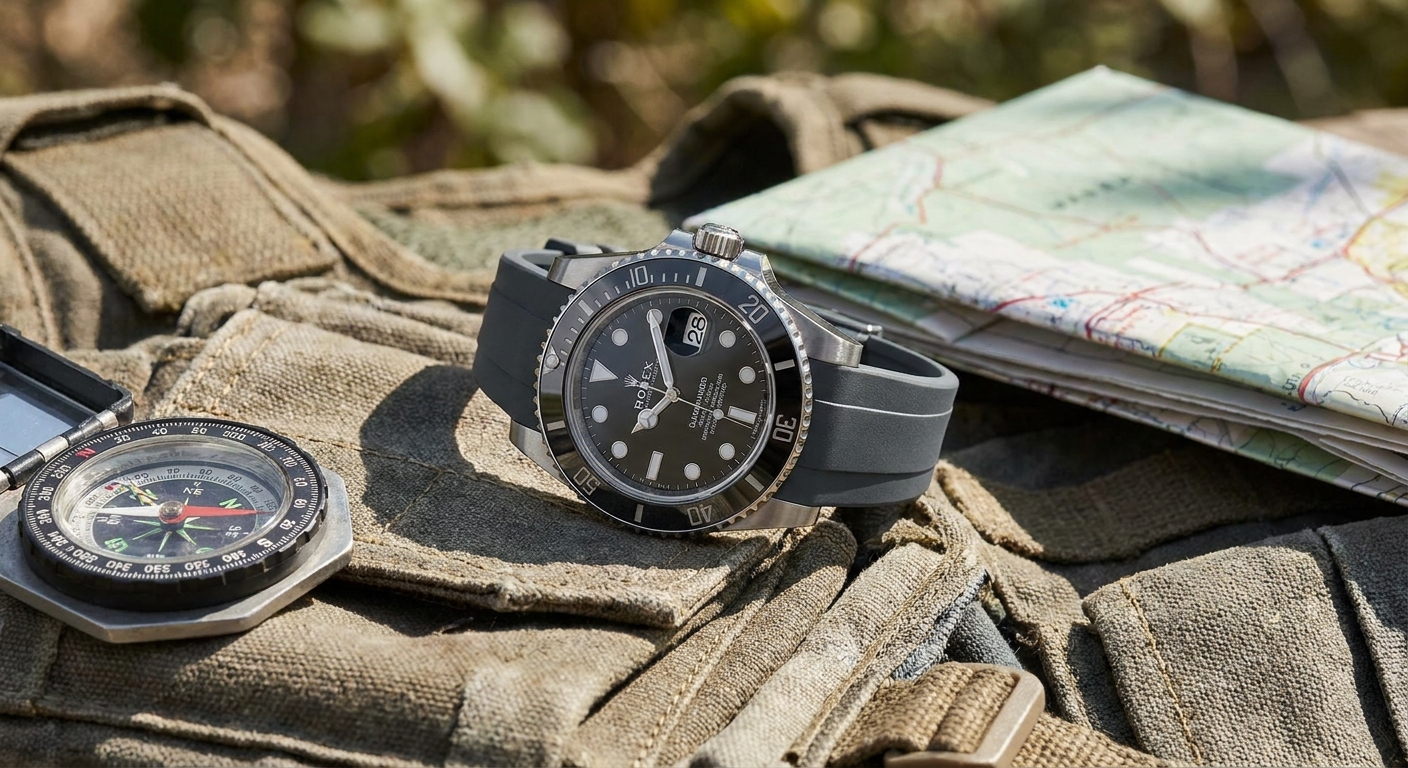
Security details, EOD teams and close-protection officers put a Rolex through worse conditions than most dive-watch reviewers ever will. This guide breaks down what a rolex rubber strap for military and security personnel actually needs to survive twelve-hour shifts, salt water and body armor cuffs, and which straps from Zerati hold up.
- The Rolex Submariner rubber strap in Swiss-made FKM is the top rolex rubber strap for military and security personnel in 2026 — buy it.
- The Rolex GMT-Master II rubber strap suits dual-time field ops; quick-release spring bars beat OEM steel bracelets for gear checks.
- Skip silicone straps — FKM resists fuel, sweat and chemical exposure that cracks cheaper rubber within months.
- Matte black FKM removes bracelet glare, a real concern for anyone working covert or low-visibility roles.
Why this matters
A steel Oyster bracelet is a liability in three specific ways for this job: it reflects light, it transmits cold and heat directly to the wrist, and it locks you into whatever link configuration you last adjusted. None of that matters at a desk. All of it matters on a checkpoint at 0400 or on a boarding team in the Gulf.
FKM (fluoroelastomer) rubber was developed for industrial and military sealing applications before it ever touched a watch strap. It holds up to fuel, hydraulic fluid, sweat salts and UV exposure far longer than natural rubber or silicone, which is exactly the exposure profile of security and military work. A Rolex rubber strap in Swiss-made FKM is not a fashion swap for this buyer — it is functional gear.
Who this is for
This guide is written for active-duty personnel, private security contractors, close-protection officers, maritime boarding teams and law enforcement tactical units who wear a Rolex Submariner, GMT-Master II, Yacht-Master or Daytona on duty and need the strap to survive conditions the factory bracelet was never built for — sweat, salt, fuel vapor, body armor cuffs and repeated glove use.
What to look for in a rolex rubber strap for military and security personnel
Chemical and fuel resistance
FKM compound resists degradation from fuel, hydraulic fluid, sunscreen and disinfectant in a way natural rubber and silicone cannot match over months of daily contact. If your straps are cracking or going tacky within a year, the compound is the problem, not the design.
Quick-release spring bars for kit checks
A strap you can swap in under a minute without tools matters when you're doing a gear inspection or switching a watch between duty and off-duty configurations. Traditional spring bars that need a pick and steady hands are a bad fit for cold fingers or gloved hands.
Low-profile, non-reflective finish
Polished steel links catch light at range and on camera. A matte black FKM strap kills that glare, which matters for anyone on a covert detail, a night operation, or working near cameras where a flash of steel draws the wrong kind of attention.
Thickness and flex for glove and cuff clearance
A strap that's too thick will fight your body armor cuff or tactical glove seal all shift. You want enough flex that the watch sits flat against the wrist under a cuff, not a strap that bridges and creates a pressure point.
Odor control in high-humidity, high-sweat conditions
Rubber that traps sweat starts smelling within weeks in Gulf humidity or jungle deployment. Vulcanized FKM sheds moisture and cleans with soap and water in a way porous rubber and leather cannot.
Clasp and bracelet compatibility
Check that the strap is built for your exact case size and clasp system — Glide Lock, Oysterlock, or the folding clasp on a Yacht-Master. A strap that doesn't match your model's lug geometry and spring bar spec will rattle or pop loose, which is unacceptable gear failure in the field.
Top picks for security and military duty
The standard-issue pick: Rolex Submariner rubber strap. Built for the 41mm ceramic case and Glide Lock clasp, this is the strap most close-protection officers already know from the factory bracelet's own tool-free adjustment system, just in Swiss-made FKM instead of steel. Priced at AED 750, it's the default choice for anyone running a Submariner through daily duty. Verdict: Buy.
The field-ops pick: Rolex GMT-Master II rubber strap. Compatible with ceramic bezel GMT-Master II models, this strap suits personnel coordinating across time zones on deployment or protective travel, where the dual-time function earns its keep. At AED 750 it matches the Submariner strap on price and compound. Verdict: Buy.
The maritime pick: Rolex Yacht-Master 40mm rubber strap. Boarding teams and maritime security units already lean on the Yacht-Master's water resistance; the rubber strap adds sweat and salt resistance the steel bracelet doesn't. This one suits water-facing roles more than dry-land patrol. Verdict: Consider.
The wildcard: Rolex Daytona rubber strap. The chronograph function is genuinely useful for timing exercises, evacuations or comms windows, but the Daytona's profile and finish read more admin-post than forward-operating. Fine for liaison and command roles, less so for boots-on-ground work. Verdict: Consider for support roles, skip for front-line duty.


What to avoid
- Silicone straps marketed as rubber. Silicone stretches and picks up odor faster than FKM under sustained sweat exposure, and it degrades quicker under sun and fuel vapor.
- Polished steel Oyster bracelets for covert or night work. They're the correct factory setup for civilian wear, but the glare and thermal transfer are a real problem for security and military duty specifically.
- Leather straps in humid climates. Leather absorbs sweat and salt, cracks and rots faster in Gulf humidity, and can't be cleaned the way vulcanized rubber can. Check the guide on rubber strap thickness for all-day comfort before assuming thicker is always tougher — it isn't.
Verdict comparison
| Model | Best for | Clasp compatibility | Verdict |
|---|---|---|---|
| Rolex Submariner rubber strap | Daily patrol, standard duty | Glide Lock, 41mm ceramic | Buy |
| Rolex GMT-Master II rubber strap | Multi-timezone deployment | Ceramic bezel models | Buy |
| Rolex Yacht-Master rubber strap | Maritime and boarding teams | 40mm case | Consider |
| Rolex Daytona rubber strap | Liaison and support roles | Standard Daytona lugs | Consider |
FAQ
What's the best rubber strap for military and security use on a Rolex?
The Rolex Submariner rubber strap in Swiss-made FKM is the strongest all-around choice for military and security duty in 2026 because it resists sweat, fuel exposure and salt while matching the Glide Lock clasp. The GMT-Master II strap is the better pick specifically for personnel tracking multiple time zones.
Is FKM rubber better than silicone for tactical wear?
Yes, FKM resists chemical, fuel and UV exposure longer than silicone under daily wear. Silicone straps tend to stretch, pick up odor and degrade faster when exposed to sweat and sun on a repeated duty cycle.
How much does a Rolex rubber strap cost in 2026?
Zerati's Swiss-made FKM straps for the Submariner, GMT-Master II, Yacht-Master and Daytona are priced at AED 750 each in 2026. Pricing is consistent across these models since they use the same compound and construction.
Can you wear a rubber strap under body armor cuffs?
Yes, a thinner FKM strap sits flatter against the wrist than a metal bracelet and clears most body armor cuffs without bridging. Check the strap thickness guide before buying if your role involves tight cuff seals.
Does a rubber strap affect Rolex water resistance rating?
A correctly fitted FKM strap does not compromise the watch's case water resistance rating, since that seal is controlled by the case and crown, not the strap. The strap itself needs to be vulcanized rubber, not a porous or stitched material, to hold up in wet conditions.
How do you clean a rubber strap after field deployment?
Rinse the FKM strap with fresh water and mild soap, then air dry fully before re-wearing. Vulcanized rubber handles this cleaning cycle repeatedly without cracking, unlike leather or fabric NATO straps.
Are quick-release spring bars durable enough for daily military use?
Yes, quick-release spring bars are rated for repeated daily removal and hold securely once seated correctly. They're actually an advantage over fixed spring bars for personnel who need to swap straps fast during gear checks.
Which Rolex models suit security personnel best?
The Submariner and GMT-Master II see the most use among security and military personnel because of their tool-watch heritage and duty-relevant functions. The Yacht-Master suits maritime-facing roles specifically due to its water resistance profile.
One last thing
The detail most buyers miss: the clasp on your Rolex, not the strap material, decides whether a rubber swap looks factory-correct or improvised. Match the strap to your exact Glide Lock or Oysterlock spec first, then pick the color and compound — reversing that order is why so many rubber strap swaps end up loose or crooked within a month.